


Since 2023, Impact Track has been expanding its range of collective impact measurement initiatives, particularly in the areas of fighting exclusion and poverty, child protection, aging well and, more recently, digital inclusion. But what exactly is sectoral impact measurement? What are the benefits and challenges? Find out how this innovative approach structures and enhances collective impact assessment.
What is a Sectoral Impact Assessment in the Social Sector?
A sectoral impact assessment brings together various stakeholders from the same sector or scheme to establish a common framework for evaluation. This approach makes it possible to:
· Harmonise indicators across the sector, whilst retaining the specific characteristics of each organisation.
· Improve understanding of sector-specific issues through a collective approach.
· Optimize the impact of the actions taken, by drawing on a more robust analysis of the results achieved.
The evaluation process is based on a cycle of continuous improvement and forms part of the concept of collective impact.
The Benefits of Sector-Wide Impact Measurement for Funders and Social Organizations
A sector-wide impact assessment addresses the need to harmonise impact data, rather than to standardise it. This type of approach is beneficial on several levels, not only for funders or networks.
For projects and social organizations, it enables :
✅ Professionnalisation and strategic management :
- A better understanding of stakeholders’ needs.
- Rigorous monitoring of the impact of activities.
- Preparation of relevant reports for funders and partners.
✅ Strengthening engagement :
- Uniting staff and volunteers around shared goals.
- Promoting their initiatives to new partners
For the sector as a whole:
✅ Cost optimisation and robust assessments.
✅ Identification of the sector’s strengths and weaknesses.
✅ Highlighting the societal value generated beyond individual achievements.
✅ Attracting new funders through consolidated evidence of impact.
Collective Impact in Action: The Case of Digital Inclusion
A collective impact assessment initiative is currently underway, led by Mednum in partnership with Impact Tank and Impact Track, with support from Orange. This initiative aims to:
- Creating a common language: by promoting a shared vision for society centred on empowering people through digital technology
- Facilitating evaluation by those on the ground: 70% of organisations wish to get started but lack support (Source: Digital Inclusion Observatory)
- Highlighting the sector’s impact: Against a backdrop of a new government and the roll-out of public policy, it is necessary to demonstrate the concrete changes brought about by these initiatives
Challenges in Scaling Impact Assessment Across a Sector
Harmonising an impact measure across a sector requires the ability to aggregate data from different initiatives. However, the diversity of initiatives, each with its own specific characteristics, can complicate this aggregation. Furthermore, it is up to the implementing organisations, which are in direct contact with beneficiaries, to collect the data. However, they struggle to measure their impact due to :
- The cost of an outsourced impact assessment (an impact report costs an average of €20,000 in France)
- The complexity of the methodologies
- The lack of in-house expertise in impact assessment
Finally, the issue of stakeholder engagement is a crucial aspect of data collection. How should these stakeholders be surveyed to maximise the number of responses and thus ensure that the results are statistically representative?
Impact assessment, although often required, is in practice rarely implemented due to a lack of resources and expertise.
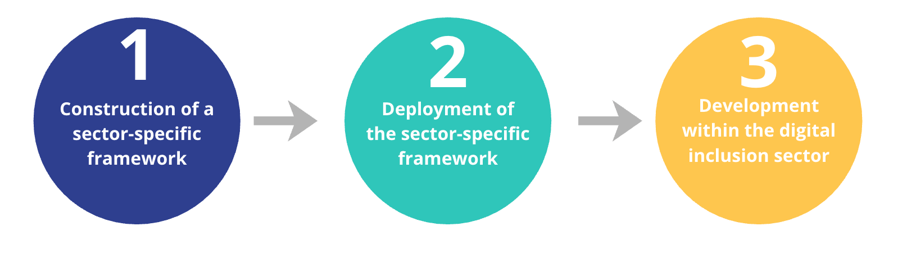
3 Key Success Factors for a Successful Sectoral Impact Assessment
Impact Track has therefore identified three key factors for the success of such an initiative:
1. Sector representativeness:
- Establishing a steering committee comprising key players in the sector,
- Identifying a representative cohort of initiatives.
The aim is to be able to approve the common framework, taking into account the interests and development of the sector.
2. A digital harmonisation tool for:
- Centralising indicators,
- Collaborative management,
- And flexible data monitoring.
3. Support for initiatives to :
- ensure the approach is fully embraced,
- Test the common framework within the initiatives,
- And take on board feedback from those working on the ground.
“At Nexem, we work with Impact Track to equip and strengthen our network in terms of advocacy through two specific sector-based initiatives: one in the field of combating exclusion and the other in the field of child protection. Their support contributes significantly to our ambition to make these initiatives sustainable, thereby enabling managing bodies to take ownership of them independently. Thanks to their expertise and platform, we are moving towards a more autonomous, sustainable and effective approach to social impact measurement.” – Ozlem Kaya, Social Innovation Project Manager
Further reading
Sector-wide impact measurement is a powerful tool for professionalising and strengthening the impact of initiatives.
💡 Want to find out more? ➡️ Read our case study on Schneider Electric impact measurement in Professional Integration.